양자 큐레이션
Quantinuum Helios: A 98-qubit trapped-ion quantum computer with all-to-all connectivity (영문)
Quantinuum Helios: A 98-qubit trapped-ion quantum computer with all-to-all connectivity

Dr. Annie Jihyun Park
Quantinuum Sr Advanced Physicist,
- 저자 Quantinuum
- 저널 Nature
- 게재일 2026. 06. 17
- 카테고리 Quantum computer
- DOI https://doi.org/10.1038/s41586-026-10676-4
KEY SUMMARY
Quantinuum Helios is Quantinuum’s latest commercial quantum computer. It is a 98-qubit trappedion processor built on the quantum charge-coupled device (QCCD) architecture which offers allto-all connectivity. It introduces three headline changes over the previous generation: a new qubit ion (¹³⁷Ba⁺), a four-way “X” junction in the trap, and a real-time software stack that compiles dynamic programs as they run. Together these roughly double the qubit count while reaching state-of-the-art fidelities, and lay the groundwork for the larger, junction-based architectures on Quantinuum’s road to fault-tolerant quantum computing.
A useful quantum computer needs two things at once: operations that are accurate enough to trust, and enough qubits to do something a classical computer cannot. Over the past decade the field has moved from controlling a handful of qubits to steering systems large enough to challenge that classical frontier, and an industrial race is now on to build practical machines across many hardware platforms. One of the leading contenders is Quantinuum, which released its newest processor, Helios, last year. Helios is a 98-qubit trapped-ion computer: its qubits are individual atomic ions held above the surface of a chip by oscillating electric fields, with quantum information encoded in long-lived hyperfine (“clock”) states of each ion. Crucially, it uses the QCCD (quantum charge-coupled device) approach, in which ions are physically shuttled around the chip so that any pair can be brought together for gating, giving Helios all-to-all connectivity. Compared with its commercial predecessor H2, Helios roughly doubles the qubit count while matching or improving on the benchmarks H2 reported at its 2023 launch. Two hardware advances make this possible: a new qubit species and a new trap geometry built around a junction, which together drive the higher performance and the larger scale. Moreover, a new control-software stack lets Helios run real-time, dynamic quantum programs, making the machine more flexible for certain quantum protocols, in particular quantum error correction (QEC).
A new trap geometry: adding a junction
The most visible hardware change is the shape of the trap (Fig. 1). H2 has a “race-track” trap: a closed linear loop in which ions circulate as an essentially one-dimensional stream (Fig. 1A) (Ions can nonetheless move past one another within the loop, so connectivity remains all-to-all). Helios instead adds a rotating ring, connected through a four-way “X” junction to a dedicated quantum-logic region (Fig. 1B). The ring is more than storage: by spinning in either direction it sorts the ions, bringing any chosen qubit to the junction on demand. This allows the ions to be sorted based on what will be gated, giving Helios its any-to-any connectivity.
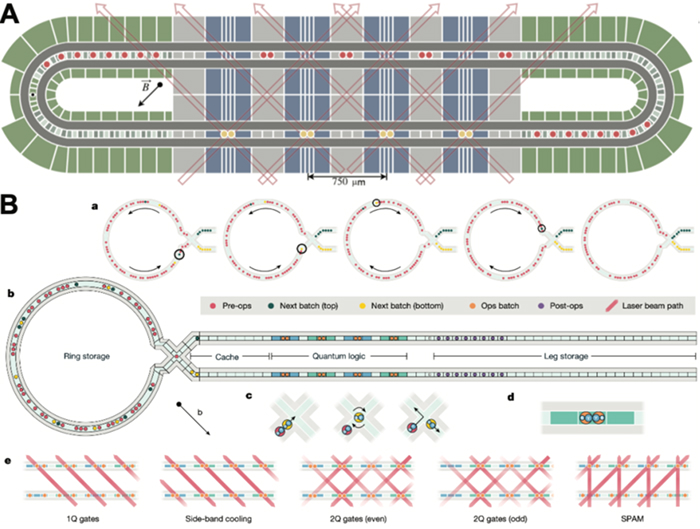
Figure 1: From a race-track to a junction. (A) The previous-generation H2 pro-cessor uses a closed “race-track” trap in which ions circulate as a quasi-one-dimensional stream[PhysRevX.13.041052(2023)]. (B) Helios adds a four-way “X” junction that connects a central rotating ring to dedicated quantum-logic regions; the ring sorts ions for any-to-any connec-tivity while keeping memory separate from processing[Nature 655, 81–86 (2026)].
This trap geometry also allows storage and processing parts of the trap to operate independently and simultaneously. The ring rotates to sort qubits and delivers them through the junction into the logic region, where the quantum operations (gates, state preparation, cooling and measurement) take place (eight operation zones, two qubits each; Fig. 1B). While that batch is being operated on, the ring is already sorting the next one and queuing it in a small cache beside the logic region. When the batch finishes, its qubits are moved out to the linear “leg” storage and the pre-sorted batch from the cache shifts in to take their place. This repeats, up to 16 qubits at a time, until every qubit in the layer has been processed, after which they return from leg storage to the ring and the next layer begins.
This parallel operation, sorting the next batch while the current one is being gated and cooled, provides a clock speed advantage. Helios achieves a “depth-1 time” (the time to apply a random permutation plus one round of single- and two-qubit gates to every qubit, i.e. one circuit layer) of about 55 ms, comparable to H2 even while roughly doubling the qubit count.
A new qubit: switching to barium
Helios is, as far as the authors know, the first programmable quantum computer to use ¹³⁷Ba⁺ as its qubit, encoding |0⟩ and |1⟩ in two long-lived ground-state hyperfine “clock” levels. The earlier H-series machines used ¹⁷¹Yb⁺ as the qubit with a barium coolant; Helios uses ¹³⁷Ba⁺ for the qubit and ¹⁷¹Yb⁺ as the sympathetic coolant. The transitions that control ¹³⁷Ba⁺ lie in the visible rather than the ultraviolet, so the lasers and optics are more mature, reliable and cost-effective. The extra laser power and better phase stability suppress several leading gate-error sources, including spontaneous emission and laser phase noise, while also making the laser architecture more scalable for future systems. Barium’s richer energy-level structure also enables a three-outcome (“ternary”) measurement that flags when a qubit has leaked out of the computational states, providing useful
How good is it? Component and system benchmarks
The team characterises Helios at two levels. Component-level benchmarks isolate each building block—single-qubit gates, two-qubit gates, state preparation and measurement (SPAM), and mid-circuit measurement and reset (MCMR)—and also quantify subtler effects such as optical crosstalk between laser beams, memory errors accumulated during transport, and leakage out of the qubit subspace. The average error rates for each component are summarized in Fig. 2, with the two-qubit number being the lowest of any commercially available quantum computer at the time of publication.
A real quantum circuit interleaves many kinds of operation—gates, measurements and resets—that can interact in complex ways. Ideally, the performance of a full circuit would simply be the sum of its component errors; in practice, hidden effects can degrade performance once everything runs together. To test for this, the authors run two system-level benchmarks that exercise all 98 qubits at once: random Clifford circuits interleaved with mid-circuit measurements (classically checkable), and mirror benchmarking of random circuits, which gauges performance on random circuit sampling (RCS). The RCS result shows that, by the authors’ analysis, classically reproducing Helios’s output would take years of exascale computing, demonstrating that the machine already operates beyond the reach of classical simulation. Crucially, both system-level benchmarks agree with what the component errors predict, confirming that no hidden effects degrade performance once all operations are run together.
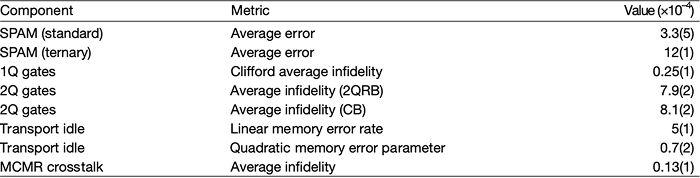
Figure 2: Benchmark summary[Nature 655, 81–86 (2026)]. Average infidelities for the main operations, measured and averaged over all locations on the device. Highlights include single-qubit gate infidelity 2.5 × 10⁻⁵, two-qubit gate infidelity 7.9 × 10⁻⁴ (99.92%) and standard SPAM error 3.3 × 10⁻⁴. Errors from ion transport (memory idle) and MCMR crosstalk are also small.
A new software stack: real-time compilation
Finally, moving ions around on the fly demands a control system that can make decisions while the program runs. Helios is the first trapped-ion machine to map a program’s “virtual” qubits onto physical ions in real time—deciding, layer by layer, which ions to fetch and how to sort them, even when the circuit’s future depends on mid-circuit measurement outcomes. This “Helios runtime” supports genuine classical control flow (if/else, loops, functions that allocate and free qubits), which users write in Quantinuum’s Pythonic quantum-classical language, Guppy. This real-time compilation makes error-correction routines and gate streaming—feeding the machine a continuous flow of gates generated on the fly rather than a fixed, pre-compiled circuit—far easier to program and to run.
Outlook
In terms of applications, Helios has been already in real use, with Quantinuum reporting applica-tions in quantum simulation of superconductivity, certified-randomness cryptography, and quantum error detection and correction. As with H1 and H2, the authors expect its fidelities and speeds to improve over time. They also argue that successfully integrating a junction is the key step toward much larger QCCD processors that can maintain all-to-all connectivity as the qubit count grows, the direction the platform will need to take toward fault-tolerant quantum computing.
About Quantinuum
Quantinuum was formed in 2021 from the merger of Honeywell Quantum Solutions and Cam-bridge Quantum. It is a worldwide operation, with dual headquarters in Broomfield, Colorado and Cambridge, UK, and further research and office sites across the USA, UK, Germany, Japan and Singapore. The company builds full-stack trapped-ion quantum computers based on the QCCD architecture—designing everything from the ion trap and control hardware up to the compiler and software. Helios is the third generation of its commercial systems, following H1 (2020) and H2 (2023), and its public development roadmap continues with Sol, Apollo, and Lumos which scale up the architecture into two-dimensional grids of junctions on the way to universal fault-tolerant quantum computing.


관련 논문 보기
 퀀텀웨이브 정기출판물
뉴스레터 구독
파동의교차,지식의융합 양자세계의 최신소식을 받아보세요.
퀀텀웨이브에서 제공하는 콘텐츠

주목할 만한 최신 연구성과
양자물리학 분야의 혁신적 연구 결과를 쉽게 풀어서 소개하고 해설합니다

양자 세부분야 리뷰
양자컴퓨팅, 양자통신, 양자센서 등 각 분야별 심화 리뷰와 동향 분석

국내 연구실 연구 동향
국내 대학 및 연구기관의 양자 관련 연구 소식과 성과를 전해드립니다
주목할 만한 최신 연구
더 많은 내용보기
열린 강의실
국가 표준에서 양자 혁명까지: 한 걸음 더 들어가 본 ‘초전도 양자컴퓨팅 시스템 연구단’

열린 강의실
"과학이 예술이 될 때”, 이화여자대학교 IBS 양자나노과학연구단을 찾아간다.

양자 큐레이션
마법 상태 재배: 자원 효율적인 오류 허용 양자컴퓨팅의 구현을 향한 진전
구글 퀀텀 AI(Google Quantum AI) 연구팀이 보편적인 오류 허용 양자 컴퓨팅의 가장 큰 난제였던 '마법 상태(magic state)' 생성 비용을 획기적으로 절감하는 새로운 패러다임, ‘마법 상태 재배(magic state cultivation)’ 기술을 제안했다. 많은 논리적 큐비트 간 상호작용을 필요로 하는 기존의 '마법 상태 증류(magic state distillation)’ 방법과 다르게, 단일 코드 패치 내에서 점진적으로 마법 상태의 신뢰도를 키워 나가는 방식을 사용한다. 그 결과, 마법 상태의 생성 비용이 CNOT 게이트와 비슷한 수준으로 감소하여, 양자 알고리즘의 실질적인 구현에 필요한 자원을 수백에서 수천 배까지 줄일 수 있는 가능성을 열었다. 이는 양자 컴퓨터의 상용화를 향한 중요한 이정표가 될 것이다.